domingo, 24 de junio de 2012

Ministro ruso de Exteriores examina con su homólogo de Turquía el incidente del avión de combate turco

Ria Novosti
Rusia

El ministro turco de Asuntos Exteriores Ahmet Davutoglu
13:04 24/06/2012
Moscú, 24 de junio, RIA Novosti.
El ministro de Asuntos Exteriores de Rusia, Serguei Lavrov, sostuvo anoche una conversación telefónica con su homólogo de Turquía, Ahmet Davutoglu, con quien examinó el incidente del avión de combate turco derribado por Siria, comunicó hoy la cancillería rusa.

"Los ministros discutieron la situación en torno a Siria en el contexto del incidente del avión de combate turco", indica el comunicado al señalar que la conversación tuvo lugar por iniciativa de la parte turca.
Un caza turco F-4 Phantom con dos pilotos a bordo, que despegó el viernes desde una base aérea en el sur de Turquía, desapareció de los radares mientras sobrevolaba el Mediterráneo en una zona fronteriza con Siria, en la provincia turca de Hatay.


Grecia pedirá alargar al menos en dos años el plazo para cumplir los ajustes

El Periódico (Catalunya)


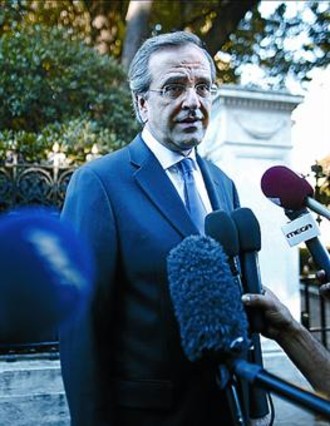
  El griego Antonis Samarás.
El griego Antonis Samarás. 

El nuevo Ejecutivo griego del conservador Andonis Samarás pedirá ampliar "al menos en dos años", es decir, hasta el 2016, el plazo acordado con la troika para cumplir el plan de reformas y ajustes fiscales, según el texto del programa del Gobierno hecho público este sábado en Atenas.
El documento pide ampliar el plazo acordado en febrero pasado por el Ejecutivo interino que había en Grecia y los representantes de la troika, compuesta por la Comisión Europea (CE), del Banco Central Europeo (BCE) y del Fondo Monetario Internacional (FMI), que se espera vuelvan a la capital helena el próximo lunes.

 Link


Morsi Is Winner of Egyptian Presidency

NY Times

Andre Pain/European Pressphoto Agency
Supporters of Mohamed Morsi, the Muslim Brotherhood candidate for president, gathered in Tahrir Square in Cairo to await the declaration of a winner on Sunday. 

CAIRO — Election regulators named Mohamed Morsi of the Muslim Brotherhood the winner of Egypt’s first competitive presidential elections, handing the Islamist group a symbolic triumph and a new weapon in its struggle for power with the ruling military council.  

After an hourlong speech in which he detailed dozens of specific inquiries down to the ballot-box level, the chairman of the election commission, Farouk Sultan, announced that Mr. Morsi had won 51.7 percent of the runoff vote completed last weekend. The other candidate, the former general Ahmed Shafik, won 48.3 percent. 

sábado, 23 de junio de 2012

Kenneth Waltz: Iranian nukes? No worries

USA Today.

The past several months have witnessed a heated debate over the best way for America and Israel to respond to Iran's nuclear activities. Although the U.S., the European Union and Iran have recently returned to the negotiating table, a palpable sense of crisis still looms.

It should not. In fact, a nuclear-armed Iran would probably be the best possible result of the standoff and the one most likely to restore stability to the Middle East.

The crisis over Iran's nuclear program could end in three ways. First, diplomacy coupled with sanctions could persuade Iran to abandon pursuit of a nuclear weapon. But that's unlikely: The historical record indicates that a country bent on acquiring nuclear weapons can rarely be dissuaded. Take North Korea, which succeeded in building its weapons despite countless rounds of sanctions and U.N. Security Council resolutions. If Tehran decides that its security depends on possessing nuclear weapons, sanctions are unlikely to change its mind.

The second possible outcome is that Iran stops short of testing a nuclear weapon but develops a breakout capability, the capacity to build and test one quite quickly. Such a capability might satisfy the domestic political needs of Iran's rulers by assuring hard-liners that they can enjoy all the benefits of having a bomb (such as greater security) without the downsides (such as international isolation and condemnation).

El BCE defiende la ayuda masiva a la banca para "salvar la economía"

Expansión
España

El miembro del consejo de gobierno del Banco Central Europeo (BCE) Ewald Nowotny defiende la masiva ayuda a los bancos en dificultades como medida para "salvar la economía", en alusión al apoyo financiero para la banca española aprobado por la Unión Europea (UE).

"Se trata de una lección aprendida de la crisis económica mundial de la década de 1930: un colapso del sistema bancario tiene consecuencias masivas en toda la economía. No salvamos a los bancos, sino a la economía", ha explicado el gobernador del Banco Nacional Austríaco en declaraciones a la radio pública ORF.

Link

Cumbre Rio+20: un texto firmado y una ola de críticas

BBC Mundo

Dilma Rousseff y Ban-ki Moon
El compromiso se negoció durante meses pero se acordó poco antes del inicio de la cumbre.

Fue definida como la mayor cumbre en la historia de la ONU, pero parece difícil que sea la más aplaudida: el encuentro Rio+20 sobre desarrollo sostenible concluyó este viernes en Brasil con un texto firmado y una ola de críticas.

El documento final de la cumbre de 191 países en Río de Janeiro abre un camino para definir metas de desarrollo sostenible a fines de 2014, señala un apoyo a la "economía verde" y prevé negociaciones para la proteger la vida marina.

Link

OPEC: Monthly report June 2012

Link

Dilma Rousseff sugiere expulsión de Paraguay del Mercosur y la Unasur

Ultima Hora
Paraguay

La presidenta del Brasil Dilma Rousseff sugirió expulsar a Paraguay del Mercado Común del Sur (Mercosur) y la Unión de Naciones Suramericanas (Unasur) a raíz de la destitución de Fernando Lugo, la cual calificó de antidemocrática.

Rousseff recordó que, tanto Mercosur como Unasur disponen de cláusulas para preservar la democracia en sus países integrantes y que podría considerarse que Paraguay transgredió una de ellas con los últimos hechos acontecidos, informó la agencia de noticias Télam.

Link

viernes, 22 de junio de 2012

Alemania, Francia, Italia y España aprueban un plan de crecimiento

Público.es
España

La llamada cumbre del crecimiento que reunió en Roma a los cuatro jefes de Gobierno de Alemania, Francia, Italia y España, hizo honor a su nombre: Merkel, Hollande, Monti y Rajoy acordaron lanzar un plan para fomentar el crecimiento en Europa por valor de 130.000 millones de euros, lo que equivale al 1% del PIB de la UE.

Después de meses pronunciando la palabra "austeridad", los líderes se atreven ahora con el crecimiento. Los cuatro grandes presentarán su propuesta en el próximo Consejo Europeo, que se celebrará en Bruselas los próximos 28 y 29 de junio. De esta forma se da satisfacción al recién nombrado presidente francés, que desde la campaña electoral francesa venía reclamando políticas de estímulo para combatir la dureza de la crisis. Sin embargo, 130.000 millones no parece una cantidad suficiente como para que el crecimiento se asiente en la UE.

Link

Urgente: Crisis política en Paraguay


Telesur TV

Unasur se reúne con representantes del Partido Colorado en Paraguay

Defesa.Net

Brasil tenta salvar o governo do Paraguai 

Infobae 

Paraguay: matanza entre policías y campesinos evidencia el conflicto agrario 

El Universo

Lugo presenta recurso de suspensión de juicio en Paraguay 

Infobae

La Iglesia pide a Lugo que renuncie

Urgente 24

Día decisivo para el complot en Paraguay


Return to capitalism 'red in tooth and claw' spells economic madness

Robert Skidelsky
Guardian

Economist John Maynard Keynes
John Maynard Keynes predicted that technological unemployment would present problems for 21st century economies. Photograph: Corbis
 
As people in the developed world wonder how their countries will return to full employment after the global recession, it might benefit us to take a look at a visionary essay that John Maynard Keynes wrote in 1930, called Economic Possibilities for our Grandchildren (pdf).

Keynes's General Theory of Employment, Interest, and Money, published in 1936, equipped governments with the intellectual tools to counter the unemployment caused by slumps. In this earlier essay, however, Keynes distinguished between unemployment caused by temporary economic breakdowns and what he called "technological unemployment" – that is, "unemployment due to the discovery of means of economising the use of labour outrunning the pace at which we can find new uses for labour".

Link

martes, 19 de junio de 2012

Julian Assange seeking asylum in Ecuadorian embassy in London

The Guardian

Julian Assange
Julian Assange has asked for asylum at Ecuador's embassy in London. Photograph: Kirsty Wigglesworth/AP

Julian Assange has dramatically sought political asylum at the Ecuadorean embassy in London, days after the supreme court rejected the last of his appeals against extradition to Sweden to face sex crime accusations and after what he called a "declaration of abandonment" by his own government in Australia.

Link

¿La Unión Bancaria Europea?

Hans Werner-Sinn
Project Syndicate

MÚNICH.– En una ostensible violación del Tratado de Maastricht, la Comisión Europea ha ofrecido un plan de rescate tras otro a las economías europeas en problemas. Ahora no solo desea socializar la deuda pública con la introducción de eurobonos, sino también la deuda bancaria, proclamando una «unión bancaria».
This illustration is by Mike Wuerker and comes from <a href="http://www.newsart.com">NewsArt.com</a>, and is the property of the NewsArt organization and of its artist. Reproducing this image is a violation of copyright law.
Illustration by Mike Wuerker
Socializar la deuda bancaria, además de ser injusto, dará como resultado una futura asignación inadecuada de recursos. La socialización de la deuda bancaria a través de las fronteras implica que el costo de los créditos privados de un país se reduce artificialmente por debajo de las tasas de mercado, ya que el seguro (que asume la forma de swaps de incumplimiento crediticio) es proporcionado en forma gratuita por otros países. Por lo tanto, los flujos de capital desde el centro a la periferia continuarán por encima del monto óptimo, debilitando el crecimiento de Europa en su conjunto.

domingo, 17 de junio de 2012

Asia’s Next Axis

Project Syndicate.

SEOUL – Last month, the leaders of China, Japan, and South Korea agreed to begin negotiations later this year on a trilateral free-trade agreement. If the talks succeed, the global trade map will need to be redrawn. An FTA that encompasses, respectively, the world’s second, third, and 12th biggest economies (in purchasing power parity terms in 2011), with a population of 1.5 billion, would dwarf the European Union and the North American Free Trade Agreement, comprising the United States, Canada, and Mexico.

 Indeed, Northeast Asia would become the third major axis of regional economic integration, following the EU and NAFTA. Until now, the region has been unable to institutionalize economic cooperation as vigorously as Europe and North America have. But if the proposals discussed in Beijing last month are realized, the resulting FTA could surpass NAFTA in its degree of integration and importance to the world economy.

In addition, the formation of a China-Japan-South Korea FTA would most likely trigger a chain-reaction. For example, the momentum could expand southward and stimulate ASEAN, which has bilateral FTAs with all three countries, to join the group. Such a turn of events would be equivalent to establishing the East Asia Free Trade Area, which the ASEAN+3 envisioned about a decade ago. If that happened, other countries – Australia, New Zealand, and, most importantly, India – might seek to jump on the bandwagon.

Think Again: Energy.

Foreign Policy.

For months, headlines have proclaimed a surge in U.S. energy production: Crude oil production in March 2012 was nearly 20 percent higher than it was on average in 2008, increasing from 4.95 million to 5.93 million barrels per day, and it is predicted to keep going up to levels not seen since the 1990s. And shale gas production has risen over the past decade from 2 percent of U.S. natural gas supply to 37 percent. While the United States still imports more than 40 percent of its oil overall, it became a net exporter of petroleum products in 2011 for the first time since 1949, and the U.S. Energy Information Administration projects that the country will become a net exporter of natural gas by 2021. So how will this U.S. uptick affect the geopolitics of energy? We asked some of the world's top experts about the consequences of growing demand in China and growing tension in Iran, the Obama administration's energy record, and -- yes -- oil prices. If they agreed on one thing, it's that we're in the midst of a shake-up of major proportions. 

jueves, 14 de junio de 2012

US backtracks on claims Russia is arming Syrian regime

The Guardian

The US state department has acknowledged that Russian helicopters it claimed had been sent recently to the Syrian regime were, in fact, refurbished ones already owned by Damascus.

Secretary of state, Hillary Clinton, claimed on Tuesday that "the latest information we have that there are attack helicopters on the way from Russia to Syria".

The state department admitted details had been omitted from Clinton's speech in which she accused Russia of escalating the violent situation in Syria. But spokeswoman Victoria Nuland said: "Whether they are new or they are refurbished, the concern remains that they will be used for the exact same purpose that the current helicopters in Syria are being used, and that is to kill civilians.

 "These are helicopters that have been out of the fight for some six months or longer. They are freshly refurbished. The question is simply what one expects them to be used for when one sees what the current fleet is doing. Every helicopter that is flying and working is attacking a new civilian location so the concern is when you add three more freshly refurbished helicopters to the fight, that is three more that can be used to kill civilians."

Clinton's accusation prompted a stern Russian denial and countercharges of hypocrisy against the US for selling military equipment, including jet engines and patrol boats, to Bahrain despite civil strife in the Arab state.

The Economic and Geo-Political Implications of China-Centric Globalization

The New America Foundation.

The last 30 years have witnessed the era of globalization which has been marked by the creation of an integrated global economy. Globalization has been the product of both policy and market forces, and U.S. policymakers have persistently been in the vanguard. However, what began as a project of globalization has been transformed with little explicit public discussion into a project of China-centric globalization.

China-centric globalization is characterized by three features: (1) the emergence of China as the global center of manufacturing, with China playing the role of factory for the world; (2) the creation of a new dollar zone shared by the U.S. and China and enforced by China’s adoption of an exchange rate pegged to the dollar; (3) the development of China as the fulcrum of U.S. engagement with the global economy, with the U.S. having a massive trade deficit with China and transferring significant chunks of manufacturing capacity to China.

Globalization has always been controversial but China-centric globalization has made it even more so. Globalization poses challenges for the character of America’s economy, for the goal of shared prosperity, and for U.S. national security. China-centric globalization amplifies these concerns by aggravating adverse economic tendencies within the globalization process, and by raising additional national security concerns about dependence on China, with whom the U.S. still has an uncertain geo-political relationship.

Looking into the future, the current path of China-centric globalization poses a threat to both U.S. economic recovery and global growth and development. It has not only hindered American attempts to escape from the post-bubble recession that began in December 2007 but it has also threatened to block future attempts to recalibrate and improve the globalization process. If anything, U.S. policy has failed to come to grips with the problems associated with China-centric globalization. Especially troubling is the U.S. Treasury’s policy toward China’s exchange rate. The Treasury’s past policy can be accused of dereliction of duty in its failure to protect the U.S. manufacturing sector. Its current policy of encouraging China to introduce a flexible yuan exchange rate with free capital mobility promises to compound that damage.

Link.

Is Brazil the next cop on the beat in Africa? The Pentagon seems to hope so

Al Jazeera.
 
New York, NY - Behind the scenes, US diplomats are reportedly becoming very leery about Brazil's rise on the world stage. An exporting dynamo with a growing middle class, Brazil has recently sought a greater role in global affairs and is discombobulating Washington in the process. Classified US diplomatic cables recently disclosed by whistle-blowing outfit WikiLeaks underscore such geopolitical tensions.

In Lima, for instance, US ambassador to Peru Curtis Struble wrote that Washington was enmeshed in an "undeclared contest" with Brazil for political influence in the Andean region. Back in the US meanwhile, right-wing hawks at the Brookings Institution view Brazil's rise with trepidation, remarking gloomily that the country "appears determined to position itself as the Latin American hegemon as it deepens its investment in various schemes of regional political and economic integration that pointedly exclude the United States".

Whatever its long term reservations about Brazil, however, Washington has apparently come round to the view that it needs the South American nation's help in the here and now. Speaking at the Brazilian War College in Rio de Janeiro recently, US Secretary of Defence Leon Panetta remarked, "This is a relationship, the United States and Brazil... between two global powers, and we welcome Brazil's growing strength. We support Brazil as a global leader, and seek closer defence cooperation because we believe that a stronger and more globally engaged Brazil will help enhance international security for all of us."


Daniel Yergin: America’s New Energy Reality.

The New York Times.

AMERICA needs a new political discourse on energy. This would recognize the emerging reality that the United States has turned around as an energy producer and is on a major upswing. And the impact will be measured not just in energy security and the balance of payments. Energy development also turns out to be an engine for job creation and economic growth — something that would hardly have been considered the last time we were electing a president. 

In 2008, the rise in oil prices was accompanied — and partly fueled — by a belief that an era of permanent scarcity was at hand. This mentality had deep roots extending back to the 1970s, when the United States went from being a minor importer of oil to a major importer. In the 2008 rendition, falling oil output was considered simply inevitable. The only questions were at what rate petroleum imports would rise and whether that rate would be slowed. 

The outlook was much the same for natural gas. Production would inevitably decline, and the country was on the way to spending $100 billion a year to import liquefied natural gas from West Africa, the Middle East, even Australia and Russia. The energy burden on our trade deficit would only increase, adding to our economic distress. 

But that is not at all how things are turning out. Technology made the difference. The natural gas market has been transformed by the rapid expansion of shale gas production. A dozen years ago, shale gas amounted to only about 2 percent of United States production. Today, it is 37 percent and rising. Natural gas is in such ample supply that its price has tanked. This unanticipated abundance has ignited a new political argument about liquefied natural gas — not about how much the United States will import but rather how much it should export. 

Estado compensador y nuevos extractivismos.

Nueva Sociedad.

Sin duda América del Sur, gobernada mayoritariamente por partidos y movimientos que se autodefinen como progresistas, ha logrado varios avances en los últimos años, en general centrados en la reducción de la pobreza y el regreso de un Estado más activo. Sin embargo, parte de los buenos desempeños van en paralelo a la consolidación de un modelo sostenido en la explotación de la naturaleza –desde el gas hasta la soja, pasando por una diversidad de productos de la minería– y la consolidación de lógicas y prácticas extractivistas. El artículo analiza las potencialidades y los límites de los nuevos «Estados compensadores», la diferencia entre viejos y nuevos extractivismos y los crecientes conflictos socioambientales.


martes, 12 de junio de 2012

Venezuela respalda candidatura de Ecuador a la secretaría general de la OPEP

El Telégrafo
Ecuador

Venezuela ratificó este martes su apoyo a Ecuador para asumir la secretaría general de la Organización de Países Exportadores de Petróleo (OPEP), responsable del 40 por ciento de la producción mundial de crudo. 

El ministro venezolano de Petróleo, Rafael Ramírez, afirmó que Caracas apoyará la candidatura a ese cargo del titular ecuatoriano de esa cartera, Wilson Pástor. El funcionario adelantó que la presencia de Pástor "sería un elemento refrescante dentro de la organización".

Reconoció, no obstante, que la decisión requerirá aún de un debate en el seno del grupo de doce países. "Hay bastantes candidatos, eso es bueno porque abre la discusión", señaló el ministro, y aludió así al hecho de que Pástor compite por el puesto con otros tres candidatos. 

El Gobierno saudí ha presentado a Mohamad al-Monif, actual gobernador permanente ante la OPEP, mientras que Irak se ha apostado por Tamir Ghadhban, asesor del primer ministro en los asuntos petroleros. 

Irán, según diversas fuentes no oficiales, ha presentado al ex ministro de Petróleo Gholam Hosain Nozari como su candidato.


Fracassa diálogo EUA-Paquistão sobre rota para o Afeganistão

DefesaNet
Brasil

Os Estados Unidos anunciaram nesta segunda-feira a retirada de seus negociadores de Islamabad, depois do fracasso das negociações para a reabertura de rotas de reabastecimento para a Otan do Paquistão ao Afeganistão.
"Foi tomada a decisão de fazer a equipe voltar para casa (Estados Unidos) por um breve período", explicou George Little, porta-voz do Departamento americano de Defesa.
A equipe de negociadores permaneceu no Paquistão por cerca de seis semanas, explicou o porta-voz do Pentágono, quando altos funcionários americanos acreditavam estar perto de conseguir um acordo com Islamabad para levantar o bloqueio aos comboios da Otan.

Yemen army in assault on militant stronghold

Gulf Times


A handout photo made available yesterday by the Yemeni defence ministry shows soldiers posing for a photo after they advanced on the frontline against Al Qaeda militants in the southern province of Abyan on Sunday

Yemeni warplanes and troops bombarded the Islamist militant stronghold of Jaar yesterday, officials and witnesses said, part of a US-backed offensive in a country Washington sees as a frontline in its war against Al Qaeda.
 
At least 44 soldiers and militants were killed as the army launched its most serious assault on Jaar to date and also attacked positions near Shaqra, a coastal town on a major shipping route, and other areas, a Yemeni military official said.

Yemen is battling to retake towns and territory in the southern province of Abyan that were seized by militants linked to Al Qaeda last year during a popular uprising against president Ali Abdullah Saleh.

El euro se la juega

Cinco Días

Las dudas de los mercados sobre la intervención quirúrgica de la zona euro en la banca española y la creciente incertidumbre sobre el resultado de las elecciones en Grecia alimentaron ayer la tensión en torno a la moneda única hasta límites desconocidos.

Mientras la Comisión Europea pedía calma y se negaba a juzgar el plan para España por la reacción bursátil en un solo día, numerosos analistas desconfiaban de las posibilidades de éxito de un rescate de la banca española que carga la factura al Estado español.

Link

Chile y su talón de Aquiles energético

Infolatam

(Especial para Infolatam por Rogelio Núñez)-. Chile aspira a convertirse a lo largo de esta misma década en un país desarrollado y alcanzar incluso a naciones europeas como Portugal. Pero para lograrlo debe solucionar el problema de su fragil matriz energética, verdadero cuello de botella para el desarrollo integral de Chile.

Ese objetivo nacional, ser un país del primer mundo, es el norte que persigue el actual ejecutivo de Sebastián Piñera. En palabras del Ministro Secretario General, Cristián Larroulet: “Chile quiere ser desarrollado a fines de esta década y para eso necesitamos energía limpia y al menor precio posible”.

Link

lunes, 11 de junio de 2012

El patrimonio neto de las familias de EE.UU. cae casi 40% entre 2007 y 2010

WSJ Americas

WASHINGTON (Dow Jones)—El patrimonio neto de los hogares estadounidenses disminuyó casi 40% entre 2007 y 2010 a niveles no registrados desde 1992.

El lunes, la Reserva Federal de Estados Unidos publicó un informe que mostró que la media del patrimonio neto de las familias disminuyó a US$77.300 en 2010, frente a los US$126.400 en 2007, lo que representa una disminución de 38,8%, el mayor descenso desde que comenzó este sondeo en 1989.

050312vachome03
Bernardi Real Estate Group

El patrimonio neto de los hogares es un indicador de los activos totales, como viviendas, acciones y pensiones, menos las obligaciones totales, como hipotecas y deuda en tarjetas de crédito. El patrimonio neto promedio cayó 14,7% en el período.

Los ingresos y el patrimonio neto de las familias estadounidenses cayeron en concordancia con las turbulencias de la economía del país durante los últimos tres años, según el Sondeo de las Finanzas del Consumidor de la Fed, un panorama detallado de las cuentas de los hogares que se realiza cada tres años.

Los hogares cuyos activos estaban más vinculados con propiedades residenciales registraron la mayor merma en su patrimonio neto medio, que declinó a US$75.000 en 2010, frente a los US$110.000 de tres años antes.

Grecia nos salvará

Slavoj Zizek
Rebelión

Texto de la intervención del filosofo esloveno en la convención de Syriza. Traducido por nemoniente.

 Al final de su vida Sigmund Freud, el padre del psicoanálisis, hizo la famosa pregunta «¿qué quiere una mujer?», admitiendo su perplejidad frente al enigma de la sexualidad femenina. Similar perplejidad surge hoy: «¿Qué quiere Europa?» esta es la pregunta que vosotros, los griegos, estáis dirigiendo a Europa. Pero Europa no sabe lo que quiere. El modo en que los estados europeos y los medios de comunicación se refieren a lo que está pasando hoy en Grecia, creo que es el mejor indicador de la Europa que pretenden. Es la Europa neoliberal, la Europa de los estados aislacionistas. Los críticos acusan a Syriza de ser una amenaza para el euro, pero Syriza es, al contrario, la única posibilidad que tiene Europa. ¿Qué amenaza?. Vosotros estáis dando Europa la posibilidad de salir de su inercia y encontrar una nueva vía.

En sus notas sobre la definición de cultura, el gran poeta conservador Thomas Eliot subrayó esos momentos en que la única elección es entre la herejía y la incredulidad, momentos en que el único modo de mantener la creencia, de mantener viva la religión, es desviarse drásticamente de la vía principal. Esto es lo que ocurre hoy en Europa. Solo una nueva herejía –representada en este momento por Syriza- puede salvar lo que merece la pena salvar de la herencia europea, la democracia, la confianza en las personas, la solidaridad igualitaria. La Europa que vencerá, si Syriza no gana, será una Europa con valores asiáticos y, naturalmente, estos valores no tienen nada que ver con Asia, sino con la voluntad actual y evidente del capitalismo contemporáneo de suspender la democracia.

Link

Alemania anuncia que la troika vigilará a la banca española

Público.es

Wolfgang Schaüble, ministro de Finanzas de Alemania.

Wolfgang Schaüble, ministro de Finanzas de Alemania.EFE

Desde que el pasado sábado se anunciara el multimillonario rescate de hasta 100.000 millones a la banca española, el ministro alemán federal de Finanzas, Wolfgang Schäuble, se ha multiplicado en los medios para tratar de explicar a los alemanes la necesidad de poner dinero para salvar a España. Dos de tres cada tres alemanes están en contra del rescate español.

Schaüble no se ha cansado de repetir desde el sábado que "España está en el camino correcto". Pero ese rescate no será sin condiciones: este lunes, en una entrevista con la radio pública alemana, Schaüble anunció que la troika formada por la Comisión de la Unión Europea (UE), el Fondo Monetario Internacional (FMI) y el Banco Central Europeo (BCE) controlará la reestructuración de la banca en España.

Tema energético y ataque a la pobreza objetivos de Araque al frente de Unasur

Telesur

Este lunes el venezolano Alí Rodríguez Araque, asumirá en Bogotá la secretaría general de la Unasur, cargo que hasta ahora era desempeñado por la colombiana María Emma Mejía. En el marco de ese traspaso de funciones, Araque participó en una entrevista exclusiva para teleSUR donde destacó que una de las metas fundamentales a futuro para la Unasur será en materia energética y también ejecutar planes sociales que combatan la pobreza.

Link

domingo, 10 de junio de 2012

¿Se puede reformar el sistema financiero global?

Paul Volcker*
Project-Syndicate

HONG KONG – En la actualidad hay abundantes pruebas de que los sistemas financieros pueden dejar de funcionar correctamente, de lo que sirven como ejemplo Asia en los noventa y Estados Unidos y Europa una década después. Cuando ello ocurre, se paga un costo intolerable en la forma de interrupción del crecimiento y desempleo.
This illustration is by John Overmyer and comes from <a href="http://www.newsart.com">NewsArt.com</a>, and is the property of the NewsArt organization and of its artist. Reproducing this image is a violation of copyright law.
Illustration by John Overmyer
Pero una reforma del sistema no será posible, o resultará muy endeble, a menos que se alcance un consenso internacional en torno a ciertos temas clave. La libertad del dinero, de los mercados financieros y de las personas para trasladarse de un lugar a otro (y, de ese modo, eludir reglamentaciones e impuestos) puede ser un freno aceptable e incluso constructivo al exceso de intervención oficial, pero no cuando eso da pie a una competencia desregulatoria entre países que impide la adopción de normas éticas y prudenciales necesarias.

* Ex presidente del directorio de la Reserva Federal de los Estados Unidos


Peru: La gran transformación

Oscar Ugarteche
ALAI

El complemento directo de “Adiós Humala” es “bienvenidos fujimoristas”. Con las técnicas y sistemas mafiosos, el gobierno de Humala ha dado el gran viraje. La llamada hoja de ruta dibuja una trayectoria de 180 grados que se ha dado constantemente desde el inicio del gobierno. Es la ruta del viraje en la política exterior ya mencionada (ver “Adiós Humala”), en la política de género, en la política ambiental y en la Política. Lo demás no tiene viraje alguno, es el piloto automático hacia la derecha natural de todo gobierno, al que se refiere Patricia del Río en su columna en un diario limeño.
Cuando dispararon contra los que protestaban en Espinar, votantes de Humala en su gran mayoría, ya estaba cumplida la hoja de ruta. El viraje ya es de 180 grados y está el partido y su jefe enfrentado a sus aliados y miembros. En la calle esto tiene como resultado el aumento de las protestas y quizás -en un efecto de bola de nieve- reproducir lo que Santos, presidente de la región Cajamarca, dijo con tanta certeza hace pocos días: procesos sociales análogos a los de Jamil Mahuad y Lucio Gutiérrez en Ecuador y Sánchez de Losada y Carlos Mesa en Bolivia. Esto por no mencionar a los que se produjeron en Argentina con “el que se vayan todos” en diciembre del 2001 o el propio pueblo peruano del 2000 cuando los cuatro suyos marcharon para sacar a Fujimori. En la calle peruana actual, los actores son los jóvenes y los afectados por la minería. Ellos no necesitan de líderes naturales. Podrían autoconvocarse bajo el lema “que me devuelvan el voto”.

The European Commission and the ECB must act now

Paul de Grauwe*
Social Europe

The seeds of the current crisis were sown nearly twenty years ago when European leaders agreed to create a currency without a country. Now, the Eurozone is split in two, with the creditor countries of the north able to borrow at next to zero interest rates, and those of the south facing massive deficits and economic instability. But both face a prescription of heavy austerity from the European Commission. Paul De Grauwe argues that the ECB and the European Commission can no longer afford to sit on the sidelines while the stability Eurozone continues to be undermined by those who fear for its future. The ECB must step in to guarantee the bonds of solvent but illiquid countries, such as Ireland, Spain, Portugal and Italy, the European Commission must encourage surplus countries to spend to offset the southern countries’ deficits, and the Eurozone must take steps towards budgetary union.

*Professor Paul De Grauwe is the John Paulson Chair in European Political Economy at the LSE’s European Institute. Prior to joining LSE, he was Professor of International Economics at the University of Leuven, Belgium. He was a member of the Belgian parliament from 1991 to 2003.

Link

viernes, 8 de junio de 2012

Scots will not be British if they vote for independence, says Miliband

Guardian

Ed Miliband speech 'Defending the Union in England' London, Britain - 07 Jun 2012
Ed Miliband adapts the union flag as a backdrop in his speech in defence of the union. Photograph: Tony Kyriacou/Rex Features
Scots will no longer be British if their country votes to leave the United Kingdom, Labour leader Ed Miliband has warned in a keynote speech on national identity.

Miliband insisted that leaving the union would mean that Scottish people would lose their British identity – challenging the argument put forward by the Scottish Nationalists, who have insisted that Scottish people would continue to be British in a geographical sense.

Alex Salmond, leader of the Scottish National party, has drawn a parallel with the way Swedish or Norwegian people can also consider themselves Scandinavian.

Rusia admite incrementar número de observadores en Siria e introducir correctivos en plan de Annan

Ria Novosti

El viceministro de Asuntos Exteriores de Rusia, Mijaíl Bogdánov, admitió hoy la posibilidad de incrementar el número de observadores internacionales en Siria e introducir ciertos correctivos en el plan del arreglo presentado por Kofi Annan, enviado especial de la ONU y la Liga Árabe.

“No descartamos aumentar, en caso de necesidad, el número” (de observadores internacionales”, reconoció Bogdánov en una entrevista con RIA Novosti.

Bogdánov, quien es enviado especial del presidente de Rusia para Oriente Próximo, señaló al mismo tiempo que “se requiere tiempo para ver cómo podemos mejorar su labor”. “Trescientos observadores militares y más de 70 civiles son una fuerza seria para determinar quién viola el armisticio”, dijo.

Link

China to loan $10 bln to SCO members states

Global Times

China to loan $10 bln to SCO members states
The large group meeting of the 12th Meeting of the Council of Heads of Member States of the Shanghai Cooperation Organization (SCO) is held at the Great Hall of the People in downtown Beijing, capital of China, June 7, 2012. Photo: Xinhua

The Shanghai Cooperation Organization (SCO)'s Beijing summit concluded Thursday with a joint communiqué outlining its future blueprint. China also pledged loans worth $10 billion to the bloc's member states to promote economic development.

In the communiqué, member states called on the international community to work for peaceful coexistence and promote coordinated, sustainable development.

Link

Autoridades decretan "preemergencia ambiental" en Santiago de Chile

Telesur

El Gobierno de Santiago de Chile decretó para este viernes la primera “preemergencia ambiental' de este año, debido a los altos índices de polución registrados y el empeoramiento de las condiciones de ventilación de la ciudad capital.

La contaminación afecta principalmente a los barrios ubicados en zona sur de Santiago, donde residen aproximadamente unos siete millones de habitantes. La medida se dicta luego de diez Alertas Ambientales que se han establecido en lo que va de 2012.

Link

A constitution for Europe


Al Jazeera

One important democratic power that was added to Iceland's new constitution is that citizens will be able to initiate legislation and it asserts that the citizens of the country hold its national resources in common[EPA]
London, UK - Last week I wrote about Ireland and Iceland and how their responses to economic crisis have differed. This week I want to explore one particular aspect of what's been happening in Iceland. When the citizens of Europe register the full extent of the problems in the financial sector, and the inadequacy of current responses, the crisis in the EU will become a constitutional matter, both in individual countries and in the European Union as a whole. At the moment Iceland is drafting a new constitution for itself. Both the method of composition and the draft proposals have some important lessons for the rest of us.

When the crisis began in Iceland in 2008, attention soon turned to the country's constitution. The current version dates back to 1944 and independence from Denmark. Though it has been adapted and revised somewhat since then, many campaigners have long wanted to start afresh. As a first step, 950 people met on November 6th, 2010 to discuss the themes and values of the new constitution in a National Forum. Normally experts and elites discuss constitutions in splendid isolation. The Icelandic approach was different. The members of the Forum were chosen at random from the Population Register 'with due regard to a reasonable distribution of participants across the country and an equal division between genders, to the extent possible'.

jueves, 7 de junio de 2012

Syria: America vs. Israel?

Foreign Policy in Focus.

The “Arab Spring” reached Syria in March 2011 when Syrian intellectuals, students, and union leaders appeared on the streets to demand greater transparency, political liberalization, and economic reforms. Although they did not participate in the initial series of demonstrations, Syrian Islamists joined the opposition after the regime responded with force to the public display of dissent. As the violence has escalated and taken over 9,000 lives, foreign powers have exploited the carnage to advance their geopolitical interests. The United States and other powers have used the Syrian Muslim Brotherhood as a proxy to topple the Syrian Ba’athist regime, which has governed for almost half a century.

Washington’s two primary interests in Syria are to strengthen the Gulf Cooperation Council (GCC) vis-à-vis Iran and to undermine Russia’s power and influence in the Middle East and Mediterranean. Israel shares the U.S. interest in cutting off Iran and Russia’s reach into the Levant.

However, security considerations surrounding the unknown variables of a post-Assad Syria appear to have created a divide between U.S. and Israeli strategies, as the Netanyahu government has not followed Obama’s course on Syria. The Israeli concerns surrounding the collapse of Syria’s Ba’athist party are legitimate. Washington should also consider the security consequences of Assad’s ouster and avoid intervention in Syria.

Denuncia del Tratado Interamericano de Asistencia Recíproca (TIAR)

Ministerio de Relaciones Exteriores Ecuador.

El TIAR fue creado como mecanismo de defensa continental colectiva como consecuencia de la Segunda Guerra Mundial y su seguimiento por la Guerra Fría, que condicionó y determinó los instrumentos jurídicos internacionales aparentemente destinados a asegurar la paz y la seguridad dentro del marco geográfico interamericano.

Sin embargo, el TIAR demostró ser un instrumento para responder supuestas agresiones de potencias extracontinentales (Unión Soviética y China), demostrando su inutilidad cuando una potencia colonial extracontinental agredió a Argentina en respuesta a su reivindicación legítima de la soberanía de las Islas Malvinas, Sandwich del Sur y Georgias del Sur, ocasión en la cual un Estado Parte del Tratado apoyó la agresión.

En la práctica, el Tratado ha perdido legitimidad y vigencia por lo que los países abajo firmantes anunciamos -en el marco de la 42 Asamblea General de la OEA- que procederemos a la denuncia formal del Tratado Interamericano de Asistencia Recíproca (TIAR), con fundamento en el artículo 25 del Tratado.

Estado Plurinacional de Bolivia
República Bolivariana de Venezuela
República de Nicaragua
República del Ecuador
Cochabamba, 5 de junio 2012.

Link 

martes, 5 de junio de 2012

Kissinger: Syrian intervention risks upsetting global order.

 Atlantic Council.

The Arab Spring is generally discussed in terms of the prospects for democracy. Equally significant is the increasing appeal — most recently in Syria — of outside intervention to bring about regime change, overturning prevalent notions of international order.

The modern concept of world order arose in 1648 from the Treaty of Westphalia, which ended the Thirty Years’ War. In that conflict, competing dynasties sent armies across political borders to impose their conflicting religious norms. This 17th-century version of regime change killed perhaps a third of the population of Central Europe.

To prevent a repetition of this carnage, the Treaty of Westphalia separated international from domestic politics. States, built on national and cultural units, were deemed sovereign within their borders; international politics was confined to their interaction across established boundaries. For the founders, the new concepts of national interest and balance of power amounted to a limitation, not an expansion, of the role of force; it substituted the preservation of equilibrium for the forced conversion of populations.

 The Westphalian system was spread by European diplomacy around the world. Though strained by the two world wars and the advent of international communism, the sovereign nation-state survived, tenuously, as the basic unit of international order.

The Westphalian system never applied fully to the Middle East. Only three of the region’s Muslim states had a historical basis: Turkey, Egypt and Iran. The borders of the others reflected a division of the spoils of the defunct Ottoman Empire among the victors of World War I, with minimal regard for ethnic or sectarian divisions. These borders have since been subjected to repeated challenge, often military.

The diplomacy generated by the Arab Spring replaces Westphalian principles of equilibrium with a generalized doctrine of humanitarian intervention. In this context, civil conflicts are viewed internationally through prisms of democratic or sectarian concerns. Outside powers demand that the incumbent government negotiate with its opponents for the purpose of transferring power. But because, for both sides, the issue is generally survival, these appeals usually fall on deaf ears. Where the parties are of comparable strength, some degree of outside intervention, including military force, is then invoked to break the deadlock.

viernes, 1 de junio de 2012

Stephen Roach: Asia Exposed.

 Project Syndicate.

NEW HAVEN – Asian authorities were understandably smug in the aftermath of the financial crisis of 2008-2009. Growth in the region slowed sharply, as might be expected of export-led economies confronted with the sharpest collapse in global trade since the 1930’s. But, with the notable exception of Japan, which suffered its deepest recession of the modern era, Asia came through an extraordinarily tough period in excellent shape.

That was then. For the second time in less than four years, Asia is being hit with a major external demand shock. This time it is from Europe, where a raging sovereign-debt crisis threatens to turn a mild recession into something far worse: a possible Greek exit from the euro, which could trigger contagion across the eurozone. This is a big deal for Asia.

Financial and trade linkages make Asia highly vulnerable to Europe’s malaise. Owing to the former, the risks to Asia from a European banking crisis cannot be taken lightly. Lacking well-developed capital markets as an alternative source of credit, bank-funding channels are especially vital in Asia.

Petróleo en caída libre en Nueva York: 83,50 dólares el barril

El Comercio.

Los precios del petróleo caían netamente este viernes en la apertura del mercado neoyorquino, afectados por un inesperado incremento del desempleo en Estados Unidos, por primera vez en un año.

Hacia las 13:00 GMT, el barril de West Texas Intermediate (designación del "light sweet crude" negociado en EEUU) para entrega en julio perdía 3,03 dólares en relación al cierre del jueves, a 83,50 dólares en el New York Mercantile Exchange (Nymex).
 
Link 
Los precios del petróleo caían netamente este viernes en la apertura del mercado neoyorquino, afectados por un inesperado incremento del desempleo en Estados Unidos, por primera vez en un año. Hacia las 13:00 GMT, el barril de West Texas Intermediate (designación del "light sweet crude" negociado en EEUU) para entrega en julio perdía 3,03 dólares en relación al cierre del jueves, a 83,50 dólares en el New York Mercantile Exchange (Nymex).

Este contenido ha sido publicado originalmente por Diario EL COMERCIO en la siguiente dirección: http://www.elcomercio.com/negocios/Petroleo-Nueva-York-dolares-precio-barril_0_710928915.html. Si está pensando en hacer uso del mismo, por favor, cite la fuente y haga un enlace hacia la nota original de donde usted ha tomado este contenido. ElComercio.com
Los precios del petróleo caían netamente este viernes en la apertura del mercado neoyorquino, afectados por un inesperado incremento del desempleo en Estados Unidos, por primera vez en un año. Hacia las 13:00 GMT, el barril de West Texas Intermediate (designación del "light sweet crude" negociado en EEUU) para entrega en julio perdía 3,03 dólares en relación al cierre del jueves, a 83,50 dólares en el New York Mercantile Exchange (Nymex).

Este contenido ha sido publicado originalmente por Diario EL COMERCIO en la siguiente dirección: http://www.elcomercio.com/negocios/Petroleo-Nueva-York-dolares-precio-barril_0_710928915.html. Si está pensando en hacer uso del mismo, por favor, cite la fuente y haga un enlace hacia la nota original de donde usted ha tomado este contenido. ElComercio.com
Los precios del petróleo caían netamente este viernes en la apertura del mercado neoyorquino, afectados por un inesperado incremento del desempleo en Estados Unidos, por primera vez en un año. Hacia las 13:00 GMT, el barril de West Texas Intermediate (designación del "light sweet crude" negociado en EEUU) para entrega en julio perdía 3,03 dólares en relación al cierre del jueves, a 83,50 dólares en el New York Mercantile Exchange (Nymex).

Este contenido ha sido publicado originalmente por Diario EL COMERCIO en la siguiente dirección: http://www.elcomercio.com/negocios/Petroleo-Nueva-York-dolares-precio-barril_0_710928915.html. Si está pensando en hacer uso del mismo, por favor, cite la fuente y haga un enlace hacia la nota original de donde usted ha tomado este contenido. ElComercio.com
Los precios del petróleo caían netamente este viernes en la apertura del mercado neoyorquino, afectados por un inesperado incremento del desempleo en Estados Unidos, por primera vez en un año. Hacia las 13:00 GMT, el barril de West Texas Intermediate (designación del "light sweet crude" negociado en EEUU) para entrega en julio perdía 3,03 dólares en relación al cierre del jueves, a 83,50 dólares en el New York Mercantile Exchange (Nymex).

Este contenido ha sido publicado originalmente por Diario EL COMERCIO en la siguiente dirección: http://www.elcomercio.com/negocios/Petroleo-Nueva-York-dolares-precio-barril_0_710928915.html. Si está pensando en hacer uso del mismo, por favor, cite la fuente y haga un enlace hacia la nota original de donde usted ha tomado este contenido. ElComercio.com

Spanish minister says future of euro at risk

Al Jazeera.

Spain saw its bond yields shoot up again after the country's economy minister said that the future of the euro would be
determined in the next few weeks and would depend on the stability of Spain and Italy.

The interest rate on 10-year Spanish bonds stood rose 0.13 percentage points to 6.58 per cent in early trading on Friday. The rate was more than 5.4 percentage points higher than the equivalent German one, which is considered a safe haven for investors.

Luis de Guindos, the Spanish economy minister, said in a speech on Thursday evening that Spain and Europe were at crossroads as speculation mounts over whether the country will need a bailout. The danger is that Spain's $1.24 trillion economy is far bigger than those of already bailed-out Greece, Ireland and Portugal combined.

Spain's banking sector is laden with soured investments on real estate and the government needs $24bn to rescue just one lender, Bankia SA, at a time of recession and crushing unemployment of 24.4 per cent.

"I don't know if we are on the edge of a cliff, but we are in a very, very difficult position,'' de Guindos said in a speech to business leaders in Sitges, a resort town near Barcelona.

Link

Obama Order Sped Up Wave of Cyberattacks Against Iran

WASHINGTON — From his first months in office, President Obama secretly ordered increasingly sophisticated attacks on the computer systems that run Iran’s main nuclear enrichment facilities, significantly expanding America’s first sustained use of cyberweapons, according to participants in the program.

Mr. Obama decided to accelerate the attacks — begun in the Bush administration and code-named Olympic Games — even after an element of the program accidentally became public in the summer of 2010 because of a programming error that allowed it to escape Iran’s Natanz plant and sent it around the world on the Internet. Computer security experts who began studying the worm, which had been developed by the United States and Israel, gave it a name: Stuxnet.